08.28.2026- IN BUSINESS
Why integrating AI today multiplies the value of your company (and how Virtual Software Factory makes it happen)

In 2026, Artificial Intelligence is no longer an experimental tool; it has become an operating layer for the business. The organizations capturing the most value are not simply “adding AI” to existing processes. They are redesigning how they sell, serve customers, operate, develop software, make decisions, and manage risk. The competitive advantage is no longer only about choosing the best model; it is about connecting AI to trusted data, real processes, internal systems, responsible governance, and measurable business outcomes.
The opportunity is massive, but so is the execution gap: many organizations use AI, while far fewer have scaled it into sustained financial impact. That is where Virtual Software Factory (VSF), with expertise in custom software, integrations, APIs, cloud, e-commerce, and automation, can turn AI potential into real, measurable, production-ready solutions.
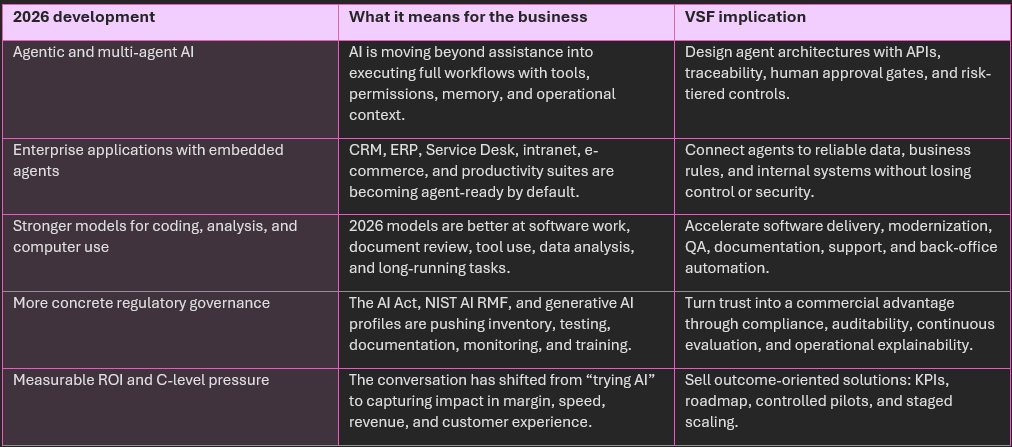
2026 executive update map
What Changed in 2026
1. From copilots to agents that execute work
In 2024 and 2025, many companies adopted copilots to write, summarize, code, or analyze information. In 2026, the most important shift is the move toward AI agents: systems that can plan, retrieve data, use tools, coordinate tasks, preserve context, and execute steps inside a workflow. The value is no longer just answering questions; it is completing processes.
• A sales agent can research an account, prepare a proposal, recommend pricing, update the CRM, and draft a follow-up email.
• A support agent can check policies, look up orders, generate responses, open tickets, escalate exceptions, and preserve a full audit trail.
• A software agent can read a repository, propose changes, modify files, run tests, and prepare technical documentation.
2. AI is connecting to enterprise systems
Modern enterprise AI no longer lives in an isolated chat window. It works across CRM, ERP, Service Desk, intranets, databases, documents, e-commerce, finance systems, calendars, approval flows, and internal APIs. This changes the conversation: a strong AI solution does not merely generate text; it understands business context and acts within controlled rules.
3. Software is being built, modernized, and maintained with AI
Software engineering is one of the areas where the 2026 impact is clearest. Coding assistants and agents can now support requirements analysis, architecture, refactoring, testing, migrations, documentation, vulnerability review, and legacy-system maintenance. For VSF, this means faster delivery, less technical friction, and safer platform modernization.
4. Governance is no longer optional
As agents gain the ability to retrieve data, execute actions, and participate in decisions, companies need clearer controls: AI system inventory, data classification, risk assessment, permissions, logs, continuous testing, monitoring, incident response, and training. In 2026, trust and compliance are no longer add-ons; they are prerequisites for scaling AI safely.
5. ROI leads the agenda
The curiosity phase is over. Executives want to know how much AI reduces cost, accelerates cycles, improves conversion, frees human capacity, reduces errors, and how that impact can be proven. AI that is not measured does not scale. Every initiative should start with KPIs, a baseline, a value hypothesis, A/B testing, an adoption dashboard, and clear criteria to continue or stop.
- Key message: The 2026 question is no longer “which model should we use?” It is “which process do we redesign, which data do we connect, which risk do we control, and which financial result will we prove?”. -
The Business Case: From Promise to Results
AI adoption continues to grow at historic speed. Generative AI has expanded at the population level, and corporate AI investment has accelerated sharply. Yet the real challenge is moving from isolated pilots to enterprise-wide impact. Leading organizations show common patterns: executive sponsorship, workflow redesign, data architecture, trained talent, system integration, and responsible governance.
In practical terms, AI value appears when it is combined with three elements:
> Trusted, accessible data: documents, databases, business rules, catalogs, operational history, and internal knowledge.
> Redesigned processes: not automating broken steps, but simplifying, measuring, removing friction, and defining new ways of working.
> Secure architecture: permissions, traceability, auditable RAG, continuous evaluation, data protection, and human oversight where needed.
Where AI Moves the Needle
Operations
Demand forecasting, dynamic planning, inventory, predictive maintenance, logistics, route optimization, simulations, digital twins, and agents that monitor operational exceptions in real time.
Sales and Marketing
Generative segmentation, campaign personalization, lead scoring, sales proposals, RFP/RFI support, dynamic pricing, competitive analysis, follow-up automation, and agents coordinating multichannel campaigns.
Customer Service
Omnichannel agents across voice, chat, email, and WhatsApp; traceable self-service; policy retrieval; intelligent escalation; faster response times; and higher CSAT/NPS.
Software, IT, and DevOps
Copilots and agents for analysis, design, coding, testing, documentation, security review, migrations, legacy refactoring, ticket automation, and DevOps/MLOps pipeline integration.
Finance and Administration
Accounts payable/receivable, reconciliations, anomaly detection, report generation, document review, controls, financial forecasting, and compliance with auditable evidence.
Human Resources and Training
Onboarding, internal-policy assistants, skill analysis, personalized training, knowledge management, and support for teams learning how to work with AI effectively.

Risk, Compliance, and Trust by Design
Adopting AI without governance can create risks: hallucinated answers, bias, data leakage, regulatory exposure, operational mistakes, unauthorized actions, intellectual property issues, and excessive vendor dependence. A professional AI implementation should include from day one:
1. Inventory of systems, models, data, vendors, and use cases.
2. Risk classification by business impact: low, medium, high, or critical.
3. Acceptable-use policies and role-based training.
4. Auditable RAG with authorized sources and version control.
5. Agent guardrails: least-privilege permissions, human approval, sandboxing, action limits, and logs.
6. Continuous evaluations: accuracy, safety, bias, robustness, cost, latency, and user experience.
7. Monitoring and incident response: metrics, alerts, traceability, rollback, and periodic review.
8. Governance aligned with NIST AI RMF 1.0, NIST AI 600-1 for generative AI, and applicable AI Act requirements.
How Virtual Software Factory Helps You Capture the Value
Virtual Software Factory builds custom software, APIs, integrations, e-commerce, automation, and cloud solutions. That foundation is essential because enterprise AI only creates real value when it connects to the systems where the business actually operates. VSF does not treat AI as a trend; it implements AI as an operational capability tied to processes, data, and outcomes.
VSF’s 7-Step Approach
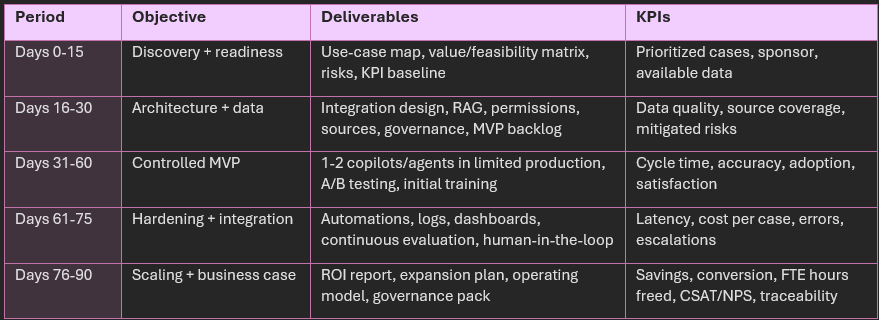
A). AI Value Discovery & Readiness (2 weeks): business and IT workshops to identify 10-20 use cases, prioritize them by value x feasibility, define risks, stakeholders, and success metrics.
B). AI-ready data and knowledge foundation: cleaning, organization, cataloging, permissions, documentation, vectorization where useful, and RAG design for reliable semantic retrieval.
C). Secure and open architecture: model and platform selection, API-first design, integration with existing systems, access control, traceability, and reduced vendor lock-in.
D). MVPs in 30-45 days: copilots and agents connected to CRM, ERP, Service Desk, web, e-commerce, documents, or databases; real-user testing and human-in-the-loop validation.
E). End-to-end automation and integration: workflows that not only answer questions but update records, generate documents, trigger approvals, create tickets, send notifications, or execute controlled actions.
F). LLMOps, MLOps, FinOps, and Responsible AI: monitoring quality, cost, latency, security, privacy, continuous evaluation, audit, robustness, operational explainability, and executive reporting.
G). Adoption, training, and operating model: role-based enablement for executives, analysts, support, sales, operations, and developers; usage manuals, governance, and continuous improvement.
Recommended Modular Packages
• Business Copilots & Agents: sales, marketing, proposals, RFP/RFI, pricing, research, CRM, and commercial follow-up.
• Customer Service AI & Voice Agents: self-service, omnichannel support, traceability, escalation, and lower time per ticket.
• AI-Powered Software Modernization: agents for development, QA, documentation, refactoring, microservices migration, and DevOps.
• Data, RAG & Responsible AI: data cataloging, semantic search, security, privacy, audit, and governance aligned with NIST/AI Act principles.
• Workflow Automation & Integrations: APIs, process automation, ERP/CRM/e-commerce/Service Desk integrations, and dashboards.
• AI for E-commerce & Digital Sales: recommendations, shopping assistants, content generation, customer analysis, and conversion automation.
A 90-Day Baseline Roadmap
In 2026, AI is not a cosmetic advantage; it is a new way of operating. The companies that win will not necessarily be the ones buying the most tools. They will be the ones redesigning processes, connecting trusted data, governing risk, and measuring results. With its experience in software, integrations, cloud, and automation, Virtual Software Factory is positioned to take organizations from idea to proven impact: quickly, safely, and value-first.
Ready to identify your highest-ROI AI use cases in two weeks and launch your first MVP in 30-45 days? Let’s talk.